Tuesday, November 17, 2009

Top Thai heat

What's the best place to soak in Siam? Having until now only visited 14 of the on this site listed 91 it would seem unfair to draw a conclusion on this. What's more there may many more hot springs, more than 100 (109 to be precise) presumably. Presumably precise?

Anyway, using a tried and trusted method used earlier I looked at the number of internet hits for a less than perfect way of ranking the Thai hot springs. Yes, where foreigners visit, hot springs will rank higher. The same applies to more accessible options. Or more developed. Flawed it may seem it is nonetheless objective in as all are rated accordingly.

What is clear is the lack of info on hot springs in Thailand. Returns to searches are often so low, that my own site is influencing the result ... Therefore I have accorded google web search double the points, see how that pans out.

The result is a photo finish with Tha Pai being number 1, Fang second. The top 10:
  • 1. Tha Pai (41 pts)
  • 2. Fang (39)
  • 3. Sankampaeng (28)
  • 4. Betong (24)
  • 5. Hin Dad and Rock Valley (22)
  • 7. Phra Ruang (16)
  • 8. Pha Bong and Pong Duet (13)
  • 10. Klong Thom (11)

  • No real surprises ...

    Would any be in my own top 10? Fang I liked as well as Hin Dad and Pong Duet. Other good soaks were Bo Klueng and Pong Phra Bat.

    Others I haven't been too which I would rate high are Klong Thom, Theppanom, Jaeson, Mae Sariang, Mae Kasa and Ranong. The wish list?

    Thursday, November 12, 2009

    Etiquette of soaking in Thailand


    One of the trickiest aspects of enjoying hot springs and (commercial) spa's in general is how to blend in, each county having different 'rules'. Naturally Thailand has it's own.

    However the way Thai enjoy their hot springs are very rule free, so it seems. It's nothing like the rules set in Northeast Asia nor the different conventions in Europe. Failing any specific guideline for enjoying hot springs in Thailand, what follows are this blogs view of what the rules are and the the background to these rules.

    In general, Thai never take a shower before hitting the hotter springs, don't ask me why. Otherwise extremely meticulous in cleanliness matters, the Thai attitude to hot springs (and bathing in natural water bodies in general) seems quite the opposite. No showering, no cleaning, that's not too difficult to remember.

    Though this aspect might be OK for lakes, sea's and rivers, I can imagine some are already put off soaking. Therefore I ask you not to proceed ...

    Bathing attire in Thailand is nearly non-existent. But not in the sense that the Thai love a skinny dip, it's quite the opposite. Taking the waters means doing so fully clothed! In some cases you will see soakers change on forehand, but most continue to jump in with the same clothes they have been using all day. Yuck! Quite unThai.
    Therefore it's advisable to avoid well visited bathing places, the water can only be a cesspool. Remember that sanitary quality is at it's best, very poor here.

    But when researching for this article I can across many websites of famous commercial spa's where nudity is de-rigeur. Six Senses, Katathani, Banyan Tree and Pimalai (as examples) all have photo's featuring naked (but tastefully avoiding anything revealing) local ladies (what about us gents?). So can one conclude that such practice only exist on private land?

    Probably. Even toplessness (but naturally (not!) this only applies to half of the world population) can be prosecuted if taking place on/in a Thai National Park.

    Looking into the etiquette of bathing in general the following (from Wikitravel) is an often repeated paragraph:
    'Swimsuits should not be revealing — many Thais swim in full clothing. Women should never go topless on the beach, especially beaches in national parks, as this is illegal and most Thais consider it offensive in the extreme. Women are sometimes advised to wear a T-shirt over their swimming gear; this is more important at primarily-Thai beach resorts, and will be almost entirely ignored at the most heavily westernized areas'.
    Couchsurf:
    'When swimming at the non tourist areas it would be polite for women to wear shorts and a t-shirt, not bikini'.
    Others add:
    'Now imagine this, Thais don't sunbathe topless, in fact they don't sunbathe at all, if they did you can bet it wouldn't be topless. Imagine what they would think seeing you with your breasts exposed to the world, or worse still, going for a skinny dip!'
    Asiatours.net:
    'Revealing clothing, worn by either men or women, is a little disgusting to most Thais. Short shorts, low cut dresses and T-shirts and skimpy bathing suits come into this category. Shorts are considered improper and low-class attire in Thailand, only acceptable for schoolchildren, street beggars, and common laborers …not wealthy tourists! Except at beach resorts, you should never wear skimpy shorts, halter tops, low-cut blouses, or anything else that will offend the locals'.
    Or into.asia.com:
    'Is it okay to go topless / nude on beaches in Thailand ? This is frowned upon in Thai culture, and you will almost never see a Thai doing it. Nevertheless, going topless on some beaches on Ko Samui, Phuket, Ko Pha-Ngan and other very touristy islands is commonplace. The locals here are used to foreigners and don't care so much. In less touristy places, particularly where there are Thai families on holiday, it is considered rude and offensive. Going nude at beaches is illegal in Thailand, and is impossible pretty much everywhere. If you really want to do this, your best bet is to find somewhere remote where you are not sure not to be seen'.
    These all lead you to believe that even wearing bathers would mean a cultural faux-pas. But is that really the case?

    A faux-pas possibly, but not necessarily a cultural one. From
    Thaivisa.com forum:
    'Against Thai culture? So a topless statue and this mural at the Grand Palace are no longer appropriate? It was only 50-60 years ago, when Thais were being persuaded to move away from their "topless culture" to dress more Western. ...
    So 50 years ago, we have a government encouraging Thai women to put their shirts on. Today we have culture 'experts' trying to tell you that it's in line with "Thai Culture" to dress modestly'.
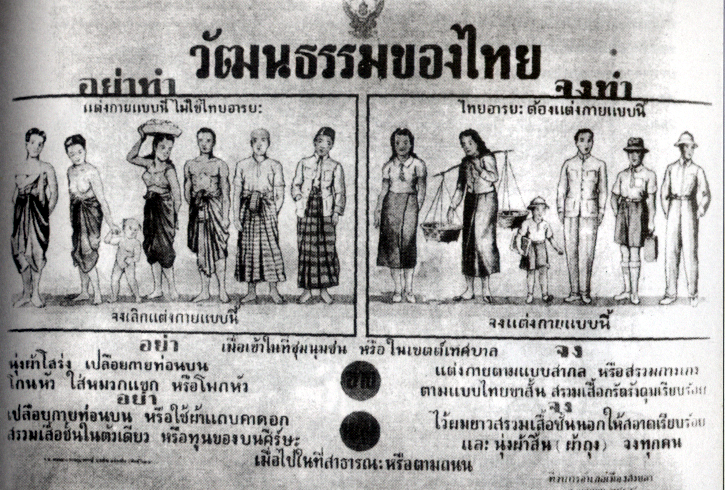
    'A Thai government poster from the Marshal Plaek Pibulsonggram
    era (1938-1945) promoting the "civilized" form of dress'.
    Left walking around in a lungi (man and woman topless) not allowed anymore.

    One can imagine that back in the time before the poster was printed bathing au-naturel had little of the supposedly cultural baggage it has nowadays. Probably there are still remote villages where bathing in the river (half) naked still takes place. At least I know this is not uncommon in neighbouring Lao which shares a similar cultural.

    This (dissenting) voice is re-inforced through the very good Thaiworldview website. In this posting it produces a number of examples of how woman's dress is on the agenda in recent politics, though the views of the government represent a conservative view whereas the modern status is:
    'Dressing is an individual's right'.
    Elsewhere the author states:
    'Skin darkness is not appreciated by Thai people because it is the symbol of the peasant. If one has its skin dark it means that he is working outside. Symbol of beauty is the skin whiteness that is why Chiang Mai girls are so reputed for their beauty. On the contrary "ISAN" women (northeastern part of Thailand), particularly near Cambodia, are not in the standard of the beauty because they have a dark skin. A Thai proverb says "black as a Cambodian". Thai people are puzzled by topless foreigner women on the beach. A normal Thai woman never has such a behavior!'
    So not cultural nor religious. It also has racial connotations. Though we could argue that these are his (and my) personal views, the site receives much positive feedback.

    And it draws parallels with the study on Bali, Paradise Created by Adrian Vickers, in which he explains how social elites try to distinguish themselves by imitating the then colonial elite and refraining from over exposure by the sun. Thus the lighter one was, the more one was to be part of the elite, i.e. one is not working on the land. This elitism though eventually trickles through the society and refraining from nudity thus becomes the local folklore. However with the advent of tourism, the dress code of the visitors is now reversing this, the less one dresses the more one is showing off that one does not need to work for money and as such this would be the new form of elitism.

    'Spring Break Thai Style'
    (
    source)
    .

    'Many of the places where I have traveled in Asia, such as Bali and Thailand, seem to be modest and have dress codes where your shoulders and feet must be covered in certain situations, yet women there can be seen walking bare-breasted down the street. It does not seem to be sexual to anyone but foreign tourists from repressed countries'.
    So where does this bring us? Unfortunately not very far. The local Thai practice is to soak clothed and anything can be frowned upon, though it's not culturally, nor religous. We can expect changes to happen as affluency permeates the society and western views of society lead to change.

    Public hot spring sites are to be taken clothed, the degree to which is dependent on the individual.There is an alternative though, most hot spring sites in Thailand rent out individual cubicles, mostly claustrophobic they contain a tub which gets filled once one pays for the use. Thus one can still take the waters as one would take a bath at home. At least that's my train of thought. However I suspect that groups rent these facilities not to enjoy a fun time letting their hair down, but to avoid having to enjoy the public facilities and thus guaranteed of more sanitary conditions ...

    From Kats' Window (on Burma and Thailand) a posting entitled Mind your Manners
    'Thankfully, Thai people are the most non-aggressive, friendly, and accepting bunch I have ever come across and are experts at acceptance. When half-naked sunburned backpackers roll into town, it looks extremely bizarre. When visitors have a day of fun sunbathing naked in Muslim areas of Thailand, Thais are not so rude as to point and laugh. But they are disturbed. They view these visitors to their country as being rude. The other side of the coin is that the visitors have money, and money is really important. Millions of tourists bring millions of dollars and are tolerated all the more because of this'.
    Though I might have had a private naked dip in one of the aforementioned cubicles, rest assured never in a public hot spring. Then again I have often made use of solitary waterholes (rivers, waterfalls) to enjoy Thailand's natural surroundings as natural as possible. Unseen!

    A final thought:
    'Can skinny dipping save the planet?
    The Bite:
    Believe it or not, it helps. Swimsuits require energy and transport to produce, while birthday suits require none. But if swimming in the buff just isn't your style, try on some eco-swimwear for size...

    The Benefits:
    • Sexy style. Give Sports Illustrated's swimsuit models a run for their money in eco-bikinis. Planet-friendly.
    • Eco-suits are made from organic and recycled materials, and 1 lb of organic cotton averts 1/3 lb of pesticides and fertilizers.
    • Eco-suits offer an eco-friendly, non-nudist way to keep sand from getting into uncomfortable places'.
    Btw: Did anyone notice that the to be broadcasted Canadian travel programme , Skinny Dip, has nothing on Thailand nor on Southeast Asia ...

    Monday, October 26, 2009

    Why?

    Followers of Soaking of Southeast Asia may well be scratching their head, why on earth start this site especially if there are only copies of the entries already seen on Soaking in Southeast Asia.

    Quite right, well here are my reasons:
    • Laying claim to the domain name
    • Responding to demand for Thai specific info
    • Possibly to market this site separately, though it remains a labour of love.
    • To make specific blog entries solely on Thailand soaks.
    • Add Thai specific links
    Though there will be future reports mimicking the aforementioned site I will be looking into wider issues though solely concentrating on Thailand. That means no updates unless it is extremely relevant and calls for a reply. I'll also be breaking the links list down more, back on the main site the never ending list not always helps visitors find what they want.

    To help my readers I've included a widget on the Soaking in Southeast Asia site which keeps tabs on entries here, so no need to surf to another web site needlessly.

    Happy soaking / Happy reading!

    Thursday, October 22, 2009

    Huh?

    Follow the signboards
    Saw a sign along the road in Namtok town, Kanchanaburi province. It indicated a left turn to go to Wang Krachae hot spring. It was only 4 kms which was fine, couldn't be too much of search.

    It turns out Wang Krachae was also the name of the sub-district. Went past the sub-district office, completed the 4 km, only to find another sign, slightly different to the first one which was placed along the 323 highway, headed for Burma. A right turn this time was required to get to 'Wangkrajae hot spring'. Distance was 3 km. Fine again, getting closer.

    The road then slowly deteriorated as well as it got steeper and nearer to the mountainside. Finally the hot spring! But it was eerily silent.
    A large car park area was obvious. There were also some small sturdy buildings and the contours of a pool. But much was overgrown.

    Where's the hot water?
    Getting out of the car disturbed a sunning rat snake; the only sign of life. It slithered away in the direction of two pools. Delicately I went up to the two pools. The greenish water in both of the pools was cool. The two buildings were open and revealed facilities (toilets), both of which could be described to be in a reasonable state of affairs. Looking further around revealed a temple-like structure, in disrepair.

    Wang Krachae's not so hot spring: beware of snakes!

    Then finally a smaller roofed structure proved to be the hot spring. The source was clear and was hot. However no outlet, so where does the water go? For sure not to the pools. There was also no one around to ask. Will it remain a mystery?

    Looks like it, internet is of no help. Only one site, by a Japanese soaker has been able to put a slight mention of Wang Krachae hot spring up on the internet. However translated it reveals less than I discovered:
    'Without I find a signboard called "WANGKRACHAEHOTSPRING" along terminal / Nam Toku Station outskirts of the train, R323 on the way and I listen considerably and turned around, but I am good, and understanding it'.
    ????

    Provincial soaks
    Prior to heading off for Kanchanaburi, I'd looked into more detail concerning the hot spring sites of the province.

    The previously posted Rock Valley I failed to find out about on forehand. Hindad (next blog post) though, is very well-known and a highlight of Kanchanaburi province, so it seems. Others I obtained from a Thai language hot springs list (starts at KC 01 and continues on next page) These are: Toong Chang, Pong Rong (twice (!), but in different locations, one in Sai Yok district, the other in Nong Prue; Pong Rong translates as hot water), Kao Pang (or Khao Pang, otherwise known as Sai Yok Noi waterfall) and Don Lamyai.

    Then there are two apparently in Sri Nagarindra in National Park:
    'Huai Mae Kamin: there are 2 hot springs, suitable for bathing'.
    I've tried to put up links to these two, but Thailands Department of National Parks website somehow fails to be linked deeply. Find your own way around our site, it seems to imply. Which is a great loss to them. Fancy putting all that information on internet and making it near impossible to find, nor to link to! Oh well, I suppose they have their reasons. Unseen Thailand indeed!

    The source itself revealed: a roof, four walls, hot water inside and a fence structure.
    But what happened? And where does the water go?

    But none of these sources revealed Wang Krachae hot spring. Obviously it had seen better times and not so long ago either. But what had changed lately? Does anyone have some answer?

    Visited August 2009.

    Wednesday, October 21, 2009

    I Love?


    Kanchanaburi
    The province of Kanchanaburi is a well trodden piece of Thailands tourist path. Besides historical highlights (as in the Burma railway), it excels in natural highlights. In this, the Erawan waterfall meets most tourists expectations of a beautiful tropical waterfall paradise.

    But there is much more nature to be discovered. Many more waterfalls and caves. So it may not be surprising that hiking and rafting are increasingly becoming popular pursuits, especially for the more wealthy middle class Bangkok citizens; Bangkok located not more than 2 hours drive from these delights.


    Hin Dat hot spring
    As said there are a couple of hot springs, non more well-known than that of Hin Dat (or Hindad / Hindard / Hindat / Hin Dad or formerly known as Kuimang; the name on the tickets though is Hindaad). Not only in Kanchanaburi, but Hin Dat rates as one of the more recognized names in hot springs in Thailand.


    Located at a fair distance from Kanchanaburi town it's just a km off the near perfect highway 323 heading west. Judging from the ample space for parking, it surely is part of the main tourist road, even a number of coach parking spaces are available. Parking outside the main gate, a small fee was required to enter, though why nationals only get charged 10 Bt and foreigners four times that amount seems a bit weird; do foreigners get more value for money?

    Beyond the gate is another parking area with many stalls around, for drinks, food, tourist nick-knacks, souvenirs and orchids / plants. Tickets get checked before a bridge. From the bridge one has a good overview of the hot spring pools themselves. This being a rainy Sunday afternoon around 3 o'clock, the sides of the two pools are lined with soakers, though not many are immersing themselves. Is the water too hot? Just a meter from the pools is a swift flowing stream; it having rained during the preceding days. The banks of the stream are also lined with people half in the water.

    Sunday afternoon: packed soakers.

    The soak
    Leaving a visit for the air-raid shelters (!) for later, I precede to the changing rooms, which are not well-maintained, but probably serve their purpose. Then down to the showers. Oddly it are mostly visitors who are leaving who are using the showers; clearly cleanliness is not an issue.

    Finding a dry spot to put my things down is quite a challenge, but once found it's off to find a spot on the side of the pool to adjust to the water. Of course there is still a place available: right next to the source, which is well over 40C apparently. After a couple of minutes I slide into the hotter of the two pools. After a nice soak, I get out and cool off in the stream.

    The bank of the stream has been lined with steps of flagstones and though the river current is strong, it's a great pleasure to enjoy a natural cooling off. By the time I'm ready for a second round, the pools are starting to clear of their visitors, possibly having to return to the big smoke. But without the crowds, the soaks are even more enjoyable. A few more rounds follow and to top off a short massage is required. All 'n all a great soak.


    Soaking Thai style.

    After wrestling back from swimwear to clothing, I walk around the site that includes a number of private soaking bungalows, a temple and the aforementioned air-raid shelters which remained from the second World War. What better protection would you need when soaking?

    Background
    As stated above Hin Dat is a well-known soak, why remains a mystery. Possibly it's accessibility together with the beautiful location of springs next to swift running stream.

    However most mentions of the hot spring concern tourist web sites mentioning the possibility of soaking.
    Some credit the Japanese occupiers (during WW II) with finding and enhancing these springs:
    '.. discovered beside a stream of cool water by Japanese troops during WWII and two cement wells were then constructed at the site'.
    Both pools are still there. However there is also the following mention:
    'This hot spring has a long history and has been with the local villagers for over 150 years'.
    It does seem logical that the hot springs were there before the Second world war, why the Japanese get the credit for discovering them is beyond me. Though no doubt they did enhance and popularise them.

    But it does seem that not much has changed since. The site has been enhanced with ample parking spaces, a bridge, changing rooms, toilets, ticket vending office and private pools. The latter though don't seem to be too popular, but they are located on the hill overlooking the site, without access to the stream and thus probably provide a less superior experience. They also cost the foreigner a foot or more, upto 1,000 Bt (~$US 30). Pay more, get less.

    Other bloggers mention
    • AbsoluteBangkok.com:
      'Well, what else you need when you got large hot water tubs lined with natural stone - and a clean (!) fresh mountain stream two meters away to cool you down again. You could rent private bath tubs, but what would you need narrow walls and a roof for when the sky’s the limit?
      ...
      And don’t trust the name of the nearby Green World Hot Spring & Golf Resort. They have no access to the hot spring water, but talk about repairs and broken pipelines and … screw them.
      All they have is a rotten jacuzzi in the cellar. Go for the real thing at the public bath. The only thing to worry: I always wonder when visiting a public bath in Thailand why you won’t find cleaner toilets than in a Thai public bath. As nobody uses the toilets'.
    • Bluestar guesthouse:
      'the springs are a God send'.
    • caryn:
      'This one is rather simple, yet it attracts numerous tourist'.
    • andydaniels:
      'The springs were really nice, big pools that fit a lot of people and were deep'.
    After four: quiet and serene.

    Other information
    There
    is also a Hin Dat hot spring festival, each year in November:
    'In the festival, there are booths of agricultural products and tourism exhibition of Amphoe Thong Pha Phum'.
    The waters are said to have as a healing property for various ailments such as beriberi and rheumatism [1], holy water that can cure diseases [2] and gout [3].

    There are two locations to stay overnight nearby: the above mentioned Green Valley which might be more appealing to golfers and the Phatad Valley Hot Springs resort, which actually is still a couple of kms away and has nothing to do with the hot springs!

    Nearby are also the Pha Tad watertfalls, probably a great place for a swim. As it is a national park, entry is a hefty 100 Bt, unfortunately during my visit three was too much water to make a swim possible. This site has more info on Pha Tad which are only located some 10 km from Hin Dat.

    Gushing waterfalls of PhaTad.

    Furthermore it should be pointed out that the hot spring is open til 22.00, which means that a late nite soak and picnic are available. Always good to know in hot Thailand.

    Then just a mention about the name, the official name is Hindad, however by far most internet links refer to it being Hin Dat. Can someone explain?

    Getting There: Traveling from Kanchanaburi town, one only needs to continue on the main 323 highway towards the Burmese border. Past the entrance to Sai Yok National park, the well signposted hot springs are just off the main road at km marker 123.

    Soaking Experience: The natural surroundings and the possibilty to cool down in the adjacent stream make Hin Dat are great place to soak. Also the possibility to stay until well into the night add to a great way to soak. The pools are deep, though the bottom is uneven.

    Overall Impression: Positive. A great place to while away a few hours preferably on the day edges, as midday sees many visitors. The food stalls even have western food and the masseurs work full time, such is their appeal.
    But I always have doubts about hygiene. Currently in Thailand you can sanitize you hands at every reception desk, though it's disputable whether the swine flu can be obtained over the counter. However without batting an eyelid, all soakers jump in in their already-worn clothing to soak; somehow missing out on the hygiene lessons. Outside of Southeast Asia though, customs (based on hygiene) determine that rigorous cleansing should take place before soaking ...


    A you tube on Hin Dat?

    Related Posts with Thumbnails