Thursday, December 10, 2009

Best Thai Soaks

Places and Prices, a Thai language coffee table magazine share with us what they believe are their best hot springs in Thailand. their best:
  • Pong Duet, Chiang Mai, north Thailand
  • Tha Pai, Mae Hong Son, north Thailand
  • Jaeson, Lampang, north Thailand
  • Raksawarin, Ranong, southern Thailand
  • Sankamphaeng, Chiang Mai, Thailand
  • Fang, Chiang Mai, north Thailand
The list includes only the six above, so are we to conclude that hot springs are not popular? Or simply not 'best'?

Monday, December 7, 2009

What would you do with a couple of million?


Recipe for Success
One of the few really developed hot spring resorts in Southeast Asia goes by the name of Hotspring Beach Resort & Spa. Located in Phang Nga province just half an hour north of Phuket airport, Southern Thailand, one would expect that this professionally run resort (***** stars it claims) to be a grand success:
  • Spa and wellness are increasingly popular tourist destinations,
  • Phuket airport is serviced from major destinations in the region as well as a selected few outside the region,
  • the area is slowly becoming a popular alternative for Phuket itself, especially with the largely undisturbed back country and
  • the fact that it's more than evident that considerable funding had been poured in to ensure a success.
But is it?

The Answer
Coming from the north, the obvious grand entrance is passed, as the resort sign is aimed for northbound traffic (coming from the airport). After a couple of minutes I turned around and this time went into the grand entrance with an absurd large driveway. That said, shaded parking space is at a premium.
But eventually after finding a spot and I'm looking around what to do, the (under-employed?) receptionist is already underway to see if I'm really going to be a client. I'm informed that the entrance to the bathing facilities is 500 Baht (about $15) which includes a free drink / snack and a towel. Not too bad. They even have locker rooms, but as I'm getting older I'm getting better at the towel changing thing.


From the reception one crosses the main free form swimming pool. At the end of this pool are two large, circular pools, to the left the warm pool, to the right the hot pool. Both pools seem slightly under maintained, but a sip of water reveals that the springs water is laden with minerals. Or sea water? The day is hot so maybe the hot pool is worth skipping, though the warm pool is too tepid. The swimming pool looks great, unfortunately it's heavily chlorinated.

Not many other guests / visitors are lounging about. The whole afternoon doesn't reveal many others. It's Phuket's main tourist season, so where are the guests?

I order my drink and snack, service is not too bad. Read a little, bath a little.

Seeing, it's a hot spring beach resort, I go in search of the beach. I'm already forewarned not to swim as it's too dangerous. Actually the resort is located on a lagoon entrance to the sea, so you'll have a lot of current. They have built a long pier which also holds a non-functioning restaurant, but as the tide is out I can take the steps to the sand below and continue for another 300 meters to the windswept and empty beach.

It's a long walk back and I'm in need of a drink. Nothing better than some tea. Deliriously I'm replied with 'we don't do that'. Fair enough. I won't disturb the staff anymore, take another soak and leave.

The swimming pool.

Their opinion
The Hotspring Beach resort and Spa expand both on their web site as well as in a brochure. They refer to their resort being:
'The one and only natural mineral hotspring beach resort and Spa in Thailand',
though the website mixes the one and only up to make it:
'The only and one natural ...'.
Concerning the hot spring:

'The hot spring source was found in this piece of land about 40 years ago. The water was originally sprung out about 3.5 m above the ground. However, due to the land development, a concrete wall was made to cover the spring which reduces its height to 1-1.5 m at the present day.
Out natural hot spring mineral water has many health benefits, such as:
  • cleanses and beautifies your skin
  • eases and soothes tired or aching muscles and joints
  • eases tension and de-stress with the comfortable water temperature (approx. 45 °C)
  • provides more effective massage by deep heating the muscles prior to your treatment
Furthermore, the elements dissolve in the water are thought to have therapeutic value, for instance:
  • Calcium is vital for bone structures and aiding in the function of muscular tissues.
  • Iron enables red blood cells to carry oxygen around the body, which is vital for the formation of the hemoglobin'.
Bare breasted fountain.
More Info
It comes as a surprise that there is hardly any info about the hot springs pre-resort.
Wikitravel ignores the resort name and refers to the hot spring being Ban Bo Dan:
'The water of the natural hot springs are laden with minerals such as sodium and calcium, which are believed to relieve rheumatism, numbness, and help lessen the tension of both body and mind, as well as being beneficial to your complexion and hair. Mineral baths are available daily'.
Ban Bo Dan is possibly the former name, before the resort was built. The resort also seems to have been under management of Dusit Hotels. At least this site mentions the hotel as Dusit Hotspring Beach Resort and Spa, though Dusit fails to mention this in their business history.
This
site reveals more history:
'In March 2002 the luxury Hotspring Beach Resort & Spa has been build',
while also maintaining the sentence 40 years before, so now more like 50 years ago. Others put the date of construction in 2004. 
 
Interestingly, Phuketdrive.com adds a picture of the original spring which he says can be visited separately as of early 2012.


 More Opinions
As it's a overnight stayable resort, there are a quite a few reviews of guests' stays from accommodating sites. In general they are widely differing in experiences. But it seems it's all about the expectations you have:

  • Yes, the resort is very big and spacious, as are the rooms.
  • However there are no nearby facilities (including beach) meaning that you are totally dependent on what the hotel offers.
And that's where it the main problems seem to be.

Elsewhere some note that the facilities themselves are
outdated (2007), lack of maintenance (2009), facilities getting old (2009). I would have to agree. At the edges Figurativly, the resort was becoming ragged and tattered. The pier for instance looked decidedly unused, piles of used towels were left for hours at a stretch, leaves were not cleared out of the pool, the communal toilet was dirty.

Though most visitors like the hot spring pools themselves. That said it comes as a surprise (as this is the only hot spring resort in Southern Thailand) that he hot springs are just mentioned as one of the many facilities: i.e. no wifi, beach too far away, airport transfer too expensive but good hot spring pool, staff a bit slow, towels too thick.

Who's the odd one out? (a.: there are two!) Source: KrAtAi

Getting there: From Phuket island head north to Khok Kloi village (8 kilometers), take a left for Natai and then 1 kilometer down this road head north again for 2 kilometers and you are there. Signage is good.

Soaking experience: With the hot springs being the focus of this multi-million investment one can certainly expect the soaking facilities to be good. They were. Though nowhere was the experience any superior than some of the other better hot springs in Thailand. If anything the artificial surroundings render it less pleasing ....

Overall impression: I'm still not fully convinced that such sprawling expanses are a boon for soaking.The resort is expansive but also deserted. What I find weird is that they do everything to make it green, but they could have also maintained a lot of the original mangrove forest. The spa could have added to the experience. I was oblivious to this and with staff being at best indifferent one does not leave with a very good impression.


More photo's from Stephen and Kate.

Thursday, December 3, 2009

Bob up

Off the trail
Despite it's presence to the nearby tourist center of Phuket (and Khao Lak), Kapong hot spring seems to be well off the tourist trail. That said the lazy environs of Kapong are altogether located in what one would suspect another world, one without tourists.


The main hot spring area. Sandbagged and ready for a soak.
The spring itself is located at the start of the pond.


Kapong
Kapong (or Ka-pong) hot spring is otherwise known (probably locally) as Plai Phu. Located in the district of Kapong in Phang Nga province, in the south of the country it's just a 2 hour drive from the hub of Phuket's hot tourist spot (Patong) or just 1 hour from Khao Lak. The town itself seems very laid back and for a district head quarter not much seems to be going on. Economic activity revolve around rubber planting with evidence of recent palm oil plantations slowly attributing to local economic significance. Furthermore, mostly small villages located between quite heavily forested mountains.


The parking area with a market stall. Some other housing (unused) behind.

The Site
There is quite a bit of parking space on gravel belong side the Le stream. Behind between the trees there are a number of bungalows and other structures which seem unused. Downstream one sees (a now cut off from the main stream) side channel with some huts and a number of port-a-loos besides. The side channel has been blocked with a dozen or so sand bags creating a half meter deep pool which is warmish. Go to the far end of the channel and the water is definitely hot. Nearby in the main stream, are a number of springs in the river bed which are hot and the main stream itself heats up.


Merge between the hot stream (left) and the main cold stream (right).

Desert?
A great place to soak up the heat especially now while the weather is cooler. But alas the main area is totally devoid of trees so during the day having a soak without getting a heat stroke is not possible so it seems. Possibly that's why the place is so deserted. What I like is that though enhanced one can see that the site has remained mostly natural. I can also imagine that come sun down this is a great place to hang out and around.


Out There
From the internet one does not become more knowledge, so it seems.
  • This site mentions water temperatures of 65 degrees Celsius.
  • A foreigner (presumably English: the_wibblywobblies notes a word of caution:
    'On departure we stopped off at a Hot Spring near Kapong. Our 5 year old inadvertently stepped into the small pool of extremely hot natural mineral water and suffered 2nd degree burns to her feet. We are planning to have a warning sign erected there but in the meantime please be careful'.
    There's no danger sign and there were some certainly very hot pools. If this were somewhere else in the western world there would be big fences around it and no bathing facilities at all.
  • Wikitravel's otherwise excellent Thailand entries fails to note the existence of the hot springs in Kapong (as laid down on the Phang Nga provincial page) though does mention the surrounding waterfalls.
  • Finally PhangNgacity.org though is more explanatory:
    'Some of the hot springs spring up in a very cold stream that flows from the mountain. It is marked by arranged-cobble stones. On the level besides the stream there are concrete wells 2 meters high, with steps up and down 3-4 wells connecting altogether, in the area of 200 square meters to contain hot spring water that bobbed up. Nowadays (2007) these hot spring have lower bob ups, which may be caused by changes underground'.
    The site also has some (better?) photo's. That includes a picture of stone structures which just might have been some soaking facilities in the past.
Did I mention forested hills?
Well opposite the soak site they are doing their best to correct this impression.


Getting there: The hot springs are just 8 km out of town. Once past the district offices heading north one needs to take the first right towards Nai Le village. The good roads continues for roughly 4 km, when this time a well signposted turn heads to another right and up the valley the road continues onward until a sudden halt as one drives into a teak forest. The unpaved track continues for another 500m and one has arrived at Kapong hot spring.

Soaking experience: Natural and alternate use of cold water are a plus. Pity the water levels are not deeper, but a superior experience. Come morning early or during sun down.

Overall impression: The place is well worth a soak if a mid day visit can be avoided. Though evidence of use widespread it'sd by no means trashed. A place to get to know.

Lots of smaller springs around the river bed.

The main spring.

The main pond with the port-a-loo's and market stalls.

Tuesday, November 17, 2009

Top Thai heat

What's the best place to soak in Siam? Having until now only visited 14 of the on this site listed 91 it would seem unfair to draw a conclusion on this. What's more there may many more hot springs, more than 100 (109 to be precise) presumably. Presumably precise?

Anyway, using a tried and trusted method used earlier I looked at the number of internet hits for a less than perfect way of ranking the Thai hot springs. Yes, where foreigners visit, hot springs will rank higher. The same applies to more accessible options. Or more developed. Flawed it may seem it is nonetheless objective in as all are rated accordingly.

What is clear is the lack of info on hot springs in Thailand. Returns to searches are often so low, that my own site is influencing the result ... Therefore I have accorded google web search double the points, see how that pans out.

The result is a photo finish with Tha Pai being number 1, Fang second. The top 10:
  • 1. Tha Pai (41 pts)
  • 2. Fang (39)
  • 3. Sankampaeng (28)
  • 4. Betong (24)
  • 5. Hin Dad and Rock Valley (22)
  • 7. Phra Ruang (16)
  • 8. Pha Bong and Pong Duet (13)
  • 10. Klong Thom (11)

  • No real surprises ...

    Would any be in my own top 10? Fang I liked as well as Hin Dad and Pong Duet. Other good soaks were Bo Klueng and Pong Phra Bat.

    Others I haven't been too which I would rate high are Klong Thom, Theppanom, Jaeson, Mae Sariang, Mae Kasa and Ranong. The wish list?

    Thursday, November 12, 2009

    Etiquette of soaking in Thailand


    One of the trickiest aspects of enjoying hot springs and (commercial) spa's in general is how to blend in, each county having different 'rules'. Naturally Thailand has it's own.

    However the way Thai enjoy their hot springs are very rule free, so it seems. It's nothing like the rules set in Northeast Asia nor the different conventions in Europe. Failing any specific guideline for enjoying hot springs in Thailand, what follows are this blogs view of what the rules are and the the background to these rules.

    In general, Thai never take a shower before hitting the hotter springs, don't ask me why. Otherwise extremely meticulous in cleanliness matters, the Thai attitude to hot springs (and bathing in natural water bodies in general) seems quite the opposite. No showering, no cleaning, that's not too difficult to remember.

    Though this aspect might be OK for lakes, sea's and rivers, I can imagine some are already put off soaking. Therefore I ask you not to proceed ...

    Bathing attire in Thailand is nearly non-existent. But not in the sense that the Thai love a skinny dip, it's quite the opposite. Taking the waters means doing so fully clothed! In some cases you will see soakers change on forehand, but most continue to jump in with the same clothes they have been using all day. Yuck! Quite unThai.
    Therefore it's advisable to avoid well visited bathing places, the water can only be a cesspool. Remember that sanitary quality is at it's best, very poor here.

    But when researching for this article I can across many websites of famous commercial spa's where nudity is de-rigeur. Six Senses, Katathani, Banyan Tree and Pimalai (as examples) all have photo's featuring naked (but tastefully avoiding anything revealing) local ladies (what about us gents?). So can one conclude that such practice only exist on private land?

    Probably. Even toplessness (but naturally (not!) this only applies to half of the world population) can be prosecuted if taking place on/in a Thai National Park.

    Looking into the etiquette of bathing in general the following (from Wikitravel) is an often repeated paragraph:
    'Swimsuits should not be revealing — many Thais swim in full clothing. Women should never go topless on the beach, especially beaches in national parks, as this is illegal and most Thais consider it offensive in the extreme. Women are sometimes advised to wear a T-shirt over their swimming gear; this is more important at primarily-Thai beach resorts, and will be almost entirely ignored at the most heavily westernized areas'.
    Couchsurf:
    'When swimming at the non tourist areas it would be polite for women to wear shorts and a t-shirt, not bikini'.
    Others add:
    'Now imagine this, Thais don't sunbathe topless, in fact they don't sunbathe at all, if they did you can bet it wouldn't be topless. Imagine what they would think seeing you with your breasts exposed to the world, or worse still, going for a skinny dip!'
    Asiatours.net:
    'Revealing clothing, worn by either men or women, is a little disgusting to most Thais. Short shorts, low cut dresses and T-shirts and skimpy bathing suits come into this category. Shorts are considered improper and low-class attire in Thailand, only acceptable for schoolchildren, street beggars, and common laborers …not wealthy tourists! Except at beach resorts, you should never wear skimpy shorts, halter tops, low-cut blouses, or anything else that will offend the locals'.
    Or into.asia.com:
    'Is it okay to go topless / nude on beaches in Thailand ? This is frowned upon in Thai culture, and you will almost never see a Thai doing it. Nevertheless, going topless on some beaches on Ko Samui, Phuket, Ko Pha-Ngan and other very touristy islands is commonplace. The locals here are used to foreigners and don't care so much. In less touristy places, particularly where there are Thai families on holiday, it is considered rude and offensive. Going nude at beaches is illegal in Thailand, and is impossible pretty much everywhere. If you really want to do this, your best bet is to find somewhere remote where you are not sure not to be seen'.
    These all lead you to believe that even wearing bathers would mean a cultural faux-pas. But is that really the case?

    A faux-pas possibly, but not necessarily a cultural one. From
    Thaivisa.com forum:
    'Against Thai culture? So a topless statue and this mural at the Grand Palace are no longer appropriate? It was only 50-60 years ago, when Thais were being persuaded to move away from their "topless culture" to dress more Western. ...
    So 50 years ago, we have a government encouraging Thai women to put their shirts on. Today we have culture 'experts' trying to tell you that it's in line with "Thai Culture" to dress modestly'.
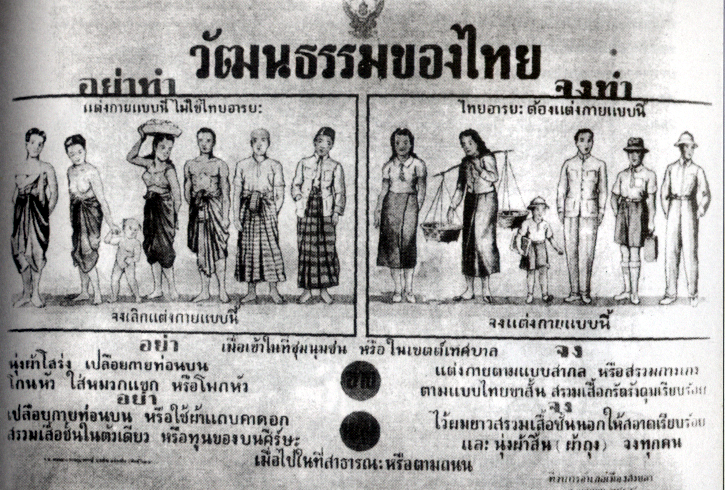
    'A Thai government poster from the Marshal Plaek Pibulsonggram
    era (1938-1945) promoting the "civilized" form of dress'.
    Left walking around in a lungi (man and woman topless) not allowed anymore.

    One can imagine that back in the time before the poster was printed bathing au-naturel had little of the supposedly cultural baggage it has nowadays. Probably there are still remote villages where bathing in the river (half) naked still takes place. At least I know this is not uncommon in neighbouring Lao which shares a similar cultural.

    This (dissenting) voice is re-inforced through the very good Thaiworldview website. In this posting it produces a number of examples of how woman's dress is on the agenda in recent politics, though the views of the government represent a conservative view whereas the modern status is:
    'Dressing is an individual's right'.
    Elsewhere the author states:
    'Skin darkness is not appreciated by Thai people because it is the symbol of the peasant. If one has its skin dark it means that he is working outside. Symbol of beauty is the skin whiteness that is why Chiang Mai girls are so reputed for their beauty. On the contrary "ISAN" women (northeastern part of Thailand), particularly near Cambodia, are not in the standard of the beauty because they have a dark skin. A Thai proverb says "black as a Cambodian". Thai people are puzzled by topless foreigner women on the beach. A normal Thai woman never has such a behavior!'
    So not cultural nor religious. It also has racial connotations. Though we could argue that these are his (and my) personal views, the site receives much positive feedback.

    And it draws parallels with the study on Bali, Paradise Created by Adrian Vickers, in which he explains how social elites try to distinguish themselves by imitating the then colonial elite and refraining from over exposure by the sun. Thus the lighter one was, the more one was to be part of the elite, i.e. one is not working on the land. This elitism though eventually trickles through the society and refraining from nudity thus becomes the local folklore. However with the advent of tourism, the dress code of the visitors is now reversing this, the less one dresses the more one is showing off that one does not need to work for money and as such this would be the new form of elitism.

    'Spring Break Thai Style'
    (
    source)
    .

    'Many of the places where I have traveled in Asia, such as Bali and Thailand, seem to be modest and have dress codes where your shoulders and feet must be covered in certain situations, yet women there can be seen walking bare-breasted down the street. It does not seem to be sexual to anyone but foreign tourists from repressed countries'.
    So where does this bring us? Unfortunately not very far. The local Thai practice is to soak clothed and anything can be frowned upon, though it's not culturally, nor religous. We can expect changes to happen as affluency permeates the society and western views of society lead to change.

    Public hot spring sites are to be taken clothed, the degree to which is dependent on the individual.There is an alternative though, most hot spring sites in Thailand rent out individual cubicles, mostly claustrophobic they contain a tub which gets filled once one pays for the use. Thus one can still take the waters as one would take a bath at home. At least that's my train of thought. However I suspect that groups rent these facilities not to enjoy a fun time letting their hair down, but to avoid having to enjoy the public facilities and thus guaranteed of more sanitary conditions ...

    From Kats' Window (on Burma and Thailand) a posting entitled Mind your Manners
    'Thankfully, Thai people are the most non-aggressive, friendly, and accepting bunch I have ever come across and are experts at acceptance. When half-naked sunburned backpackers roll into town, it looks extremely bizarre. When visitors have a day of fun sunbathing naked in Muslim areas of Thailand, Thais are not so rude as to point and laugh. But they are disturbed. They view these visitors to their country as being rude. The other side of the coin is that the visitors have money, and money is really important. Millions of tourists bring millions of dollars and are tolerated all the more because of this'.
    Though I might have had a private naked dip in one of the aforementioned cubicles, rest assured never in a public hot spring. Then again I have often made use of solitary waterholes (rivers, waterfalls) to enjoy Thailand's natural surroundings as natural as possible. Unseen!

    A final thought:
    'Can skinny dipping save the planet?
    The Bite:
    Believe it or not, it helps. Swimsuits require energy and transport to produce, while birthday suits require none. But if swimming in the buff just isn't your style, try on some eco-swimwear for size...

    The Benefits:
    • Sexy style. Give Sports Illustrated's swimsuit models a run for their money in eco-bikinis. Planet-friendly.
    • Eco-suits are made from organic and recycled materials, and 1 lb of organic cotton averts 1/3 lb of pesticides and fertilizers.
    • Eco-suits offer an eco-friendly, non-nudist way to keep sand from getting into uncomfortable places'.
    Btw: Did anyone notice that the to be broadcasted Canadian travel programme , Skinny Dip, has nothing on Thailand nor on Southeast Asia ...
    Related Posts with Thumbnails